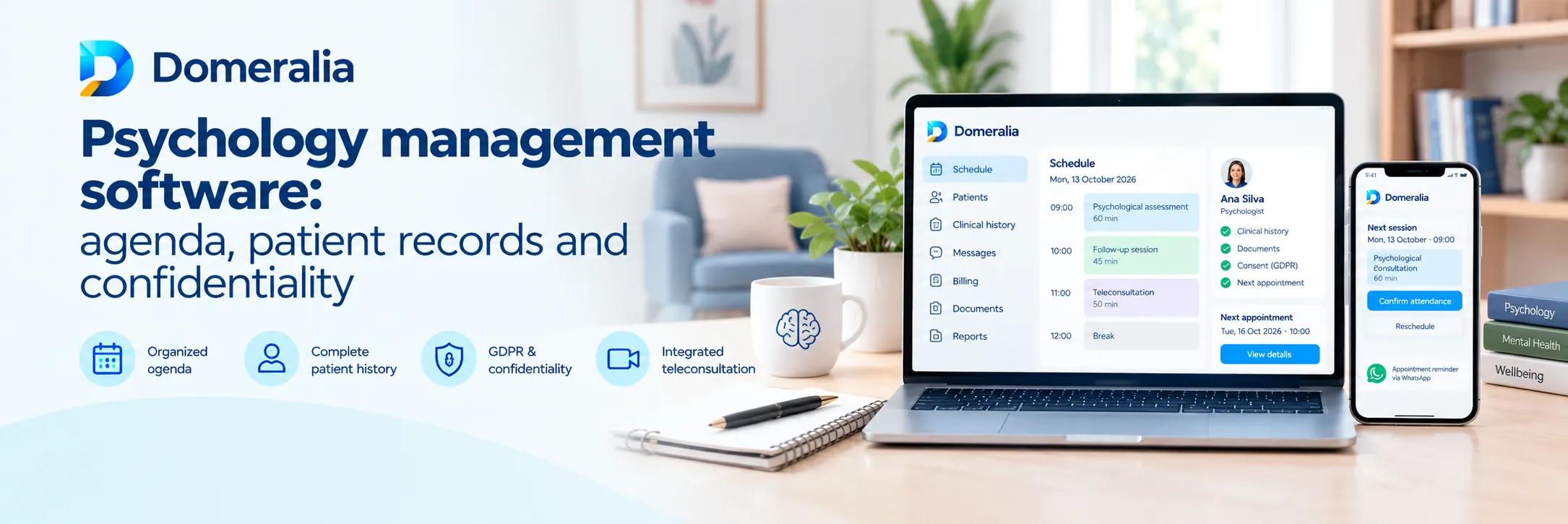
Psychology practice management software is not the same as a video-call tool. Teleconsult matters — a lot — but the practice rests on a reliable diary, usable clinical records, clear payments and demonstrable confidentiality. If you want to organise the full practice, start with the product view at Domeralia for psychology. This article covers day-to-day management; if your focus is specifically the online channel, see the companion piece on telehealth for psychologists: online sessions under control.
Practice management vs telemedicine: do not confuse the problem
Many psychologists arrive at software after no-shows, folder records or WhatsApp as “clinical history”. Others arrive because they want to offer online sessions. The needs overlap but differ:
- Telemedicine: quality of remote session, virtual room, online/in-person labelling, continuity of the clinical act at a distance.
- Practice management: diary, reminders, records, documents, permissions, checkout, reporting and compliance.
You can have excellent video and still lose money to cancellations, or a perfect diary and improvised teleconsult. Domeralia addresses both, but this post prioritises the operating system of the practice. The teleconsult piece fits as a channel inside that system, not a substitute.
Clinical diary: more than a pretty calendar
In psychology, the diary is containment: weekly or fortnightly frequency, report-writing slots, supervision and non-clinical blocks. Good software allows:
- Appointment types (first, follow-up, couple, online, in-person) with different durations.
- Reminders that reduce missed appointments without feeling intrusive.
- Visibility of states (confirmed, cancelled, did not attend) so you are not fooled by a “full” diary.
- Access limits: not everyone should see every patient if you have reception or colleagues.
The diary is the front door; the record is where therapeutic work is protected. If you only digitise the calendar, you digitise reception — not the consulting room.
Clinical record: minimum usability without endless bureaucracy
The psychology record must balance rigour and flow. Too many fields kills adoption; an endless note block kills retrieval. In practice it helps to have:
- Contact details and reference people where appropriate.
- Presenting issue and reviewable therapeutic goals.
- Session notes with a minimum structure agreed by the clinician or centre.
- Documents (reports, consents, referrals) versioned in one place.
- Relevant alerts (risk, frequency agreements, channel preference).
The client/patient record is the container; your clinical judgement defines the content. What matters is availability at the next session — in person or online — without searching email.
Confidentiality and GDPR: requirement, not slogan
In psychology, confidentiality is not a legal footnote: it is a condition for the therapeutic relationship. Software should help you:
- Minimise who sees what (roles and permissions).
- Record lawful bases and consents where they apply.
- Avoid insecure channels as the usual home for clinical history.
- Support access, rectification and erasure rights with traceability.
Review in detail GDPR capabilities in Domeralia. Compliance is not only “servers in Europe”: it is designing habits (what you write, where you share, what you export). A generic ERP without a clinical lens often fails day to day: coarse permissions, bulk exports or notes visible to profiles that should not see them.
Online and in-person on one thread
Hybrid practice is normal. A patient may do three online sessions and return in person after travel. If the channel lives outside the software (personal Zoom + paper diary), you break traceability.
Integrate teleconsult as an appointment type within the same record and the same history. Then the question is not “where is the link?” but “what do we work on today given the clinical thread?”. For depth on running remote sessions — room, control, labelling — read telehealth for psychologists; here we stay on the full management frame.
Payments, reports and the clinician’s boundaries
Management is also professional self-care. Without a system, the psychologist becomes an administrator at night: invoices, reminders, hunting for notes. Reasonable software reduces that second shift.
- Clear payment and status per session or session package, if you use them.
- Report templates so you do not rewrite structure every time.
- Separation between clinical time and admin time in the diary.
You do not need the most complex software on the market; you need one the team (even if it is just you) uses every day. The software for psychology landing summarises that focus: less operational friction, more mental space for the session.
Centres with several psychologists: permissions and data culture
When the practice grows from one clinician to a centre, the risk is no longer only “losing a note” but “who can see what”. Management software should allow distinct profiles: admin sees diary and payments; the clinician sees their caseload; leadership sees aggregated indicators without reading others’ histories by default.
Also agree minimum writing hygiene: what is documented, what tone is used, what is not copied to external channels. The tool does not replace clinical supervision, but it makes dangerous shortcuts visible (export to personal Excel, forward screenshots, mix patients in one messaging thread).
If you also offer online, unify channel labelling and criteria for what is signed at a distance. Again: teleconsult is a mode of care within the same record system, not a silo.
Common mistakes when digitising a psychology practice
- Starting with video and leaving the record for “later”. Later never comes and chaos only changes screen.
- Duplicating tools: a consumer calendar, Drive, WhatsApp Business and Zoom with no link between them.
- Writing too much or too little: unreadable novel minutes vs zero retrievable record.
- Granting wide access “for convenience” to reception or colleagues without clinical need.
- Ignoring operational cost: not only monthly fee but admin hours. Compare plans on pricing.
Good digitisation shows on Tuesday at 9:05, when you open the record and pick up the thread without logistical anxiety. If at that hour you are still hunting the link or the note, you do not yet have management — you have patches.
Checklist for choosing psychology management software
- Diary + record + documents on the same patient?
- Permissions compatible with reception or a multidisciplinary centre?
- Integrated teleconsult, not a parallel workaround?
- Real GDPR tools and habits (see GDPR)?
- Can I recover the clinical thread in under a minute before I start?
- Do price and plan fit my volume? See pricing.
If you answer “yes” to the essentials, you are choosing practice management. If you only look at video quality, you are choosing a channel. Both matter; do not swap one for the other.
Frequently asked questions
What should psychology practice management software include?
At minimum: diary with appointment types, clinical record with notes and documents, access control, GDPR support, basic payments and — if you work online — teleconsult integrated on the same patient. An isolated calendar is not enough.
Is it the same as a telemedicine platform?
No. Telemedicine focuses on the remote session. Management software covers full practice operation (diary, record, confidentiality, administration). They can coexist; they are not equivalent.
How does software help confidentiality?
Through roles and permissions, centralising history outside insecure channels, logging consents where applicable and clearer processes for GDPR rights. The tool supports; professional and centre habits remain decisive.
Do I need a digital record if I work alone in private practice?
Yes, if you want continuity, fast search and less risk of lost information. Working alone does not remove data protection duties or the hidden cost of notes scattered across places.
Can I combine online and in-person sessions?
Yes. Ideally label the channel in the diary and keep one record. Then the therapeutic thread does not split across Zoom, paper and WhatsApp. Teleconsult should be an appointment type, not a parallel system.
Where do I start if I have no software yet?
Prioritise diary + record + permissions, set reminders and define what you write each session. Then integrate teleconsult and refine payments. Start with Domeralia for psychology and add layers only when the base habit is settled.
Run your psychology practice on Domeralia: try free · see pricing