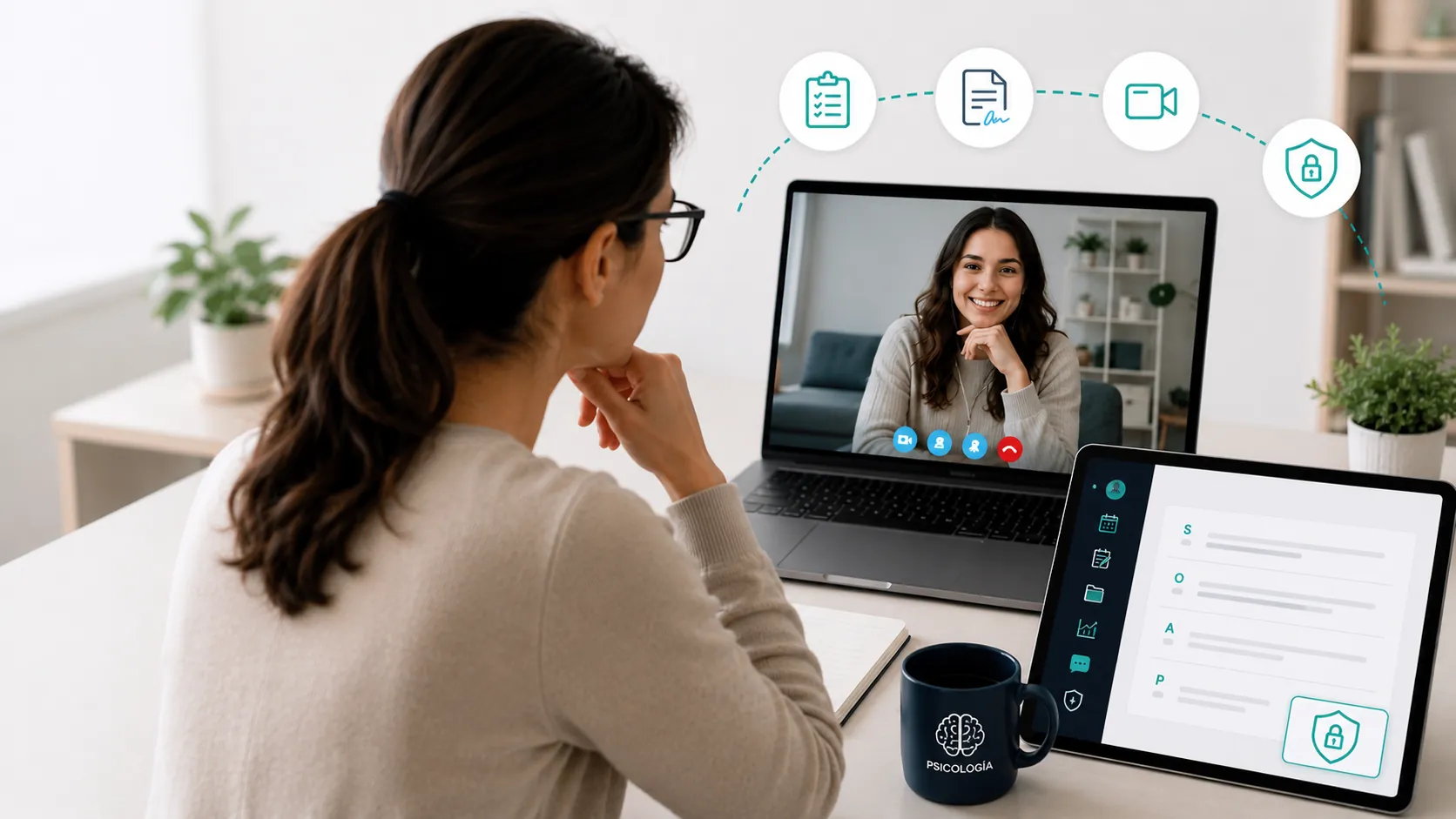
Online consultations (Telemedicine) have ceased to be an exception and become a standard way to access psychotherapy. Patients who live far away, who cannot travel due to anxiety or reduced mobility, or who simply prefer sessions from home, now expect their psychologist to offer this option with the same level of seriousness as an in-person visit.
The issue is not technological — dozens of video calling tools exist. The problem is clinical and administrative: where is this consultation recorded? How is the informed consent signed if the patient never enters the clinic? How do you handle billing and follow-ups without duplicating work between the video call and the patient file?
Why telemedicine in psychology is not “just a video call”
Unlike cosmetic procedures, in mental health, the medical history is the core of the service. Every session — whether in-person or online — must be documented with the same traceability: what was worked on, how the patient progressed, and what plan was set for the next session. If an online session remains ‘outside the system’, in loose notes or in the professional’s memory, the exact clinical and legal value of the follow-up is lost.
Added to this is a sensitive point in this niche: confidentiality. Psychology patients are particularly cautious about who accesses their data and how it is stored. Offering telemedicine without a clear data protection module can be, for many patients, reason enough not to take the step.
What a psychology practice needs to offer serious telemedicine
- Booking and confirmation as formal as an in-person session. The patient should be able to book their online session, receive confirmation and reminders, just as if they were stepping into the office. Treating online sessions informally — ‘see you on video call, I’ll let you know later’ — conveys less professionalism and leads to more no-shows.
- Informed consent with digital signature before the first session. This is not an optional procedure in mental health: the patient needs to understand and accept how online follow-up will be conducted, what is recorded, and who has access, with a timestamped record in their clinical file.
- Structured recording of each session (SOAP). Documenting every consultation in the same format — Subjective, Objective, Assessment, Plan — whether in-person or online, maintains continuity of care and makes it easy to pick up the therapeutic thread, even if weeks pass between sessions.
- Active data protection from day one. Given the sensitive nature of psychology records, having an active GDPR module — consents, access control, traceability — is not an extra: it is an essential condition for patients to trust and take the step toward online sessions.
- A direct contact channel without relying on personal WhatsApp. Many psychologists end up managing patients through their personal WhatsApp, blurring private life with work. Having integrated reminders and messaging within the management system avoids this overlap and maintains the professional boundaries psychologists often recommend to their patients.
A hybrid practice, not two parallel systems
The most common mistake when adopting telemedicine is treating it as a separate service: a Google Calendar schedule for online sessions and paper or Excel files for in-person ones. This multiplies administrative workload and, worse, fragmentates the patient’s clinical history — precisely in the discipline where continuity matters most.
The alternative is a single file per patient, where it doesn’t matter whether the session was in-person or via video call: SOAP records, consent forms, appointment history, and billing all live in the same place.
Conclusion
Offering telemedicine in psychology is not just about turning on a video call: it is about maintaining the same level of clinical rigor, confidentiality, and traceability as in-person appointments. With Domeralia’s 360° patient file, digitally signed medical history, SOAP records, and built-in GDPR module, your practice can offer online sessions without fragmenting clinical records or compromising patient trust.
Try Domeralia free for 14 days and manage your in-person and online consultations in a single system.