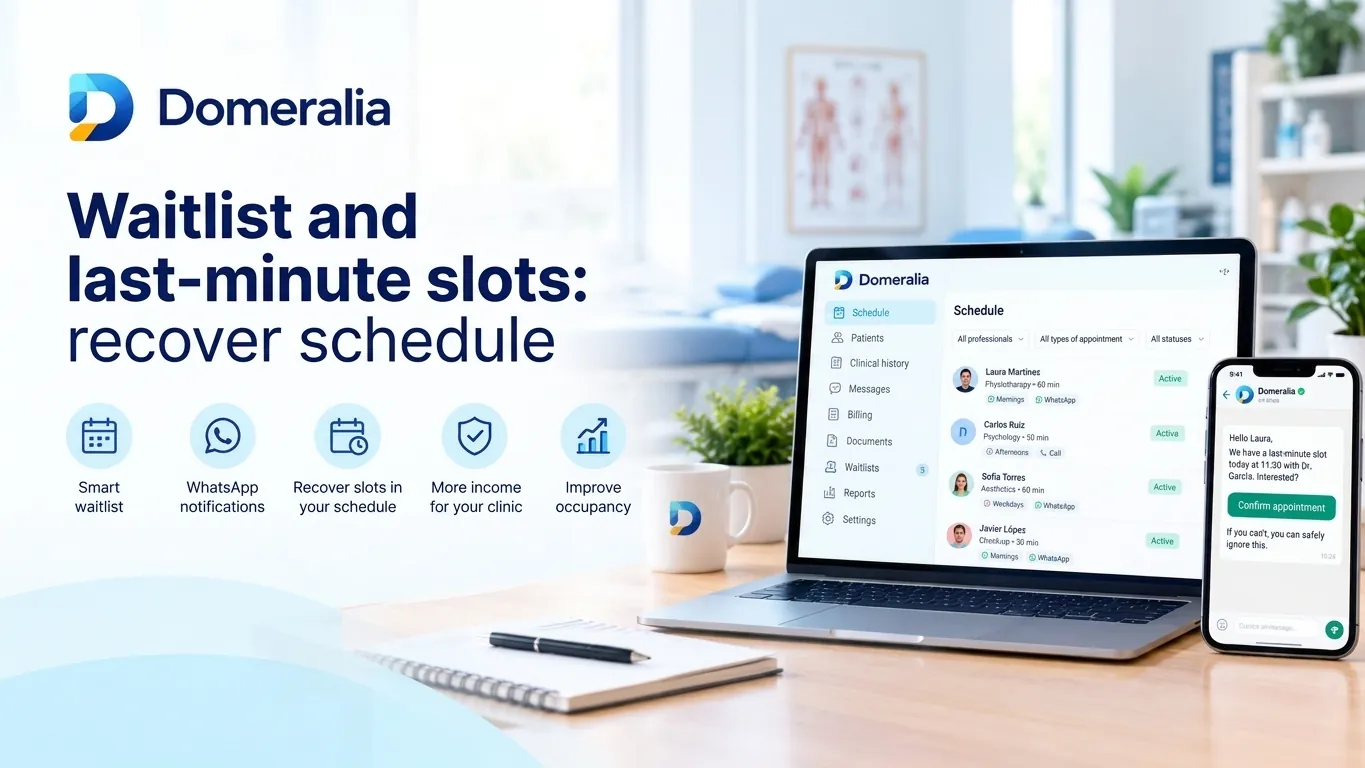
A cancellation three hours ahead does not have to be a net loss. It can be a recoverable gap if you keep a live waiting list and a fast channel to notify people. Most clinics see the same pattern: the diary “collapses” in the afternoon and reception improvises calls to contacts they remember. With a waiting list and WhatsApp, the process stops depending on whoever is on the desk. This article explains how to reclaim last-minute diary time without harassing patients or breaking your booking policy.
The real cost of a gap (beyond an empty appointment)
A last-minute gap costs:
- Revenue not earned by the clinician and the room.
- Product or preparation already opened for some treatments.
- A knock-on effect: if the first appointment cancels, it sometimes spreads a “quiet day” feeling.
- Team demotivation when recovery is chaotic.
Preventing no-shows is still the first line — see reducing no-shows in advanced aesthetic clinics and how to avoid client no-shows. The waiting list is the second line: what you do when the gap appears.
A useful waiting list: criteria, not an endless list
A waiting list nobody segments is a graveyard of names. To work at the last minute you need minimal metadata:
- Real availability: mornings, afternoons, weekdays only, notice with X hours.
- Appointment type / clinician / room they will accept.
- Perceived urgency: acute pain, touch-up, review, first visit.
- Notification channel: WhatsApp often beats a cold call.
- Interest expiry: if there has been no response for months, archive.
The waiting list in Domeralia is there to turn that inventory into action when a slot frees up — not to accumulate false hope from patients who already solved their problem elsewhere.
Last-minute gap protocol (30–15–5)
Define a short protocol reception can run without thinking:
- Minute 0: mark the appointment cancelled / no-show and release the gap in the diary.
- Minutes 0–5: filter compatible waiting-list candidates (clinician, duration, type of act).
- First notification: a clear WhatsApp message to 1–3 candidates (not twenty at once unless you control double booking).
- Confirmation: only one “yes” confirms and blocks; the rest get a polite close if the gap is filled.
- Minutes 15–30: if no response, second tier (next segment or a call).
The classic mistake is messaging the whole list “can anyone come now?” with no system: you get three yeses, one angry patient and rescheduling chaos. Better a few well-chosen contacts and a gap status the team can see.
WhatsApp: speed with respectful rules
WhatsApp is the natural channel for last-minute because patients actually read it. It is also where tone and compliance get improvised most. Internal agreements:
- Short templates: gap, time, clinician, how to confirm, how long you hold it.
- Notification window (avoid the small hours).
- Real opt-out: anyone who does not want last-minute alerts should leave that segment.
- Do not discuss sensitive clinical matters in the diary-recovery thread.
Integrating WhatsApp with diary operations cuts copy-paste from the receptionist’s personal phone — another control and GDPR leak. The waiting list suggests candidates; WhatsApp sends the alert; the diary confirms the outcome.
It fits no-show prevention (it does not replace it)
If you live on recovering gaps, you have an upstream problem. The waiting list is a safety net, not the main strategy.
Combine:
- Reminders and advance confirmation (fewer surprise gaps).
- Cancellation policy known at booking.
- Deposit or conditions on high-cost treatments where it makes sense.
- Waiting list for what still slips through.
The articles how to avoid client no-shows and no-shows in advanced aesthetics cover prevention. Here we close the loop: when prevention fails, you recover.
Metrics to know if the waiting list pays off
- % of last-minute gaps recovered (realistic initial goal: improve month on month).
- Mean time to fill from cancellation.
- Response rate to WhatsApp alerts by time band.
- % of double contact / conflict (should trend to zero).
- Candidate source (formal list vs reception’s informal favourites).
If reception still calls “Maria because she is always free”, you have bias: a few patients absorb all flexibility and others never get a chance. A formal list democratises opportunity and protects relationships.
Roll-out in one week
- Day 1: define which gaps deserve a protocol (minimum duration, clinicians included).
- Day 2: move real names into the waiting list with availability and appointment type.
- Day 3: draft 2 WhatsApp templates (alert + gap filled).
- Day 4: team dry run (simulated cancellation).
- Day 5: go live; review at close how many gaps you saved.
In seven days you will not eliminate cancellations. You can stop treating an empty gap as inevitable. A reclaimed diary is reclaimed revenue — and less frustration at reception.
Segments that convert best at the last minute
Not every name on the list responds equally. Prioritise, with ethical and clinical judgement:
- Patients in active follow-up who asked to be seen sooner.
- People who declared flexible hours (remote work, shift patterns).
- Lists by clinician: someone who already trusts that professional accepts a change faster.
- First visits only if the gap allows proper duration and preparation — do not squeeze a 60-minute assessment into a 25-minute leftover.
Do not use the waiting list as punishment (“we’ll put you on the list”) without managing time expectations. Transparency — “we’ll notify you if something compatible frees up within 72 hours” — beats vague promises.
In specialties with high no-show rates, combine this with the confirmation discipline in how to avoid no-shows. In high-ticket aesthetics, no-shows in advanced aesthetic clinics covers prevention; the waiting list closes recovery.
Governance: do not depend on one person at reception
If only one person “knows who to call”, your diary recovery is fragile. Document the protocol on one internal page: filters, WhatsApp templates, contact order and what to do with late replies. Train the whole front desk.
Review list hygiene weekly: remove non-responders, update availability, drop duplicates. A clean list of 40 useful names beats 200 dead contacts.
Finally, celebrate the KPI as a team: gaps saved = revenue recovered. When reception sees the impact, the protocol stops being “another step” and becomes operational pride.
Frequently asked questions
What is a waiting list in a clinic?
It is an ordered register of patients who want an earlier appointment or will accept gaps when someone else cancels. It should include availability, appointment type and notification channel; a loose note at reception is not enough.
How do you recover a last-minute gap?
Release the appointment in the diary, filter compatible candidates on the waiting list and notify a controlled number of people on a fast channel (often WhatsApp) until one confirms. Then close the gap and tell the rest if needed.
How many patients should I contact at once?
Start with one to three well-filtered candidates. Contacting the whole list with no control creates double bookings and poor experience. Scale only if your process clearly shows when a gap is still open.
Does a waiting list replace anti-no-show reminders?
No. First you prevent cancellations and no-shows; then you recover the inevitable. They are complementary layers. Without prevention, the waiting list saturates and reception lives in emergency mode.
What role does WhatsApp play in this flow?
It gives response speed on recent cancellations. Use templates, time windows and opt-out, integrated into operations — not as improvised personal chat from the team.
Which indicator should I watch in the first month?
The percentage of last-minute gaps you manage to fill and mean time to fill. If coverage rises without more double-booking conflicts, the protocol is working.
Recover gaps with Domeralia: free trial · see pricing