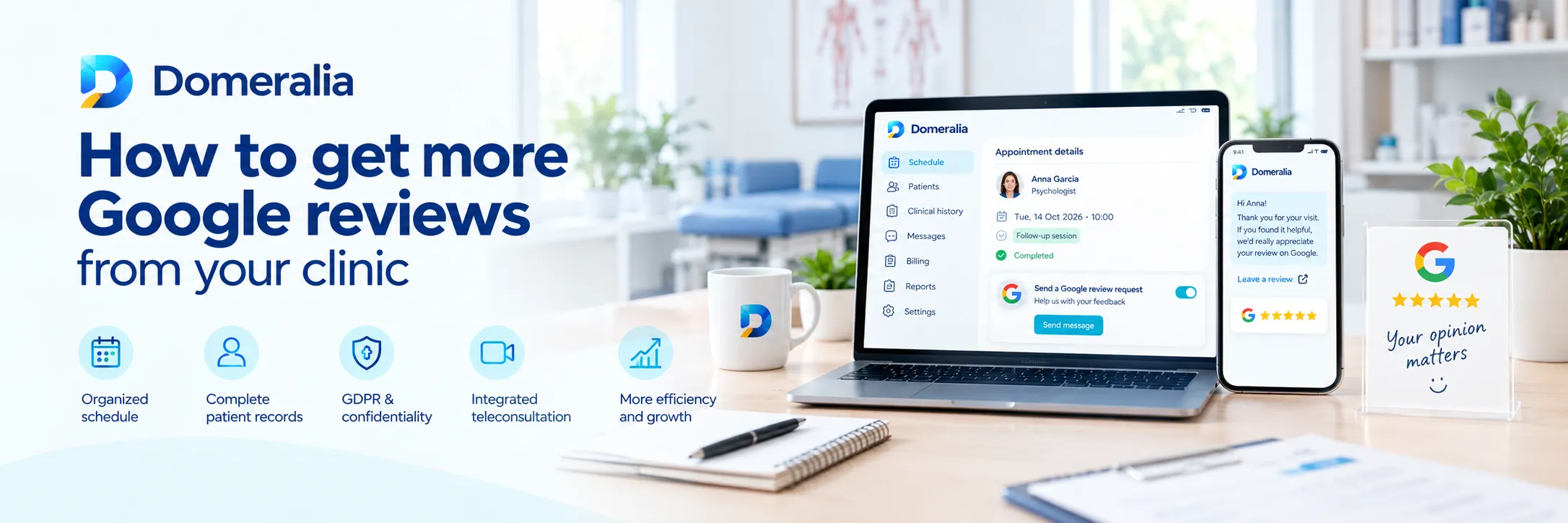
Everyone knows reviews matter. Almost nobody has a flow that earns them consistently without hassling the patient. This article does not re-explain “why Google rules”: we covered that in the importance of Google reviews for businesses. Here we go operational: how to get more Google reviews from your clinic — who asks, when, via which channel and how to measure the funnel without reception improvising.
From importance to flow (the missing step)
Online reputation is an asset; the post-visit flow is the process that feeds it. If your team only “asks for a review when they remember”, you get spikes after a campaign and droughts the rest of the month. The goal is a habit as stable as appointment reminders: triggered by visit status, short message, correct link and respect for the patient’s moment.
The product piece this post points to is Google reviews in Domeralia: automate the request at the right moment, not replace human judgement.
The real funnel: visit → satisfaction → request → review
Think in four measurable stages:
- Eligible visits: appointments completed (not no-shows).
- “Green” visits: no serious incident, payment closed, patient happy (human filter or ultra-short survey).
- Requests sent: message with direct link to leave a review.
- Reviews published: new ratings in the period (ideally attributable to the flow).
If you only watch total reviews for the month, you do not know whether satisfaction, sending or the link failed. The funnel tells you where to act.
When to ask: timing matters more than copy
Asking at reception while the patient pays in a rush often yields polite nods and zero reviews. Moments with better conversion:
- Right after a satisfactory visit, with the clinician or reception offering a short link (“if today was helpful, a Google review helps us a lot”).
- 2–24 hours later, when the patient is home and can write calmly — ideal via WhatsApp.
- After a plan milestone (end of package, discharge, visible result in aesthetics), not after a first exploratory visit when rapport is still thin.
Do not ask for a review the same day as an incident (long delay, confusing payment, doubtful outcome). Recover the experience first; then, if appropriate, ask for private feedback — not a forced public star rating.
Who asks: clear role, not “someone will do it”
Define an owner for the process:
- Reception: sends the standard message and logs exceptions (“do not send: incident”).
- Clinician: gives the human cue (“your Google opinion would help us”) when the visit closes well.
- Management: weekly review of requests vs reviews and public responses to reviews.
If everyone is responsible, nobody is. Automatic trigger + one human line from the clinician usually beats a poster at the desk.
The message: short, honest, one link
Base template (adapt tone to your clinic):
“Hi [Name], thank you for your visit today at [Clinic]. If it was helpful, would you leave us a Google review? It takes less than a minute: [link]. Thank you!”
- One CTA: review.
- No blackmail (“only if you give us 5”).
- Do not ask for an essay: people review more when effort feels low.
- Direct link to your profile’s review flow, not a generic Google search.
WhatsApp wins on open rates; the patient portal / booking landing can reinforce the same link in a branded space if you already use the portal for appointments or documents. What matters is not multiplying destinations.
Ethics and compliance: what you must not do
- Do not invent reviews or ask staff to pose as patients.
- Do not offer consideration in exchange for stars (conflicts with Google policies and trust).
- Do not filter “only happy people” deceptively: you can choose timing, not silence legitimate criticism.
- Always respond to public reviews — including negative ones — with facts and a private contact route.
A clinic that responds badly to a 2-star review loses more than the star: it loses the narrative for future patients who read the replies.
20-minute weekly routine
- Review how many green visits vs requests sent (is the filter too strict?).
- Review request → review rate (if low: link, timing or text).
- Reply to new reviews (positive with brief thanks; negative with empathy + private channel).
- Spot recurring themes in comments (wait, manner, results) and pass them to operations — reviews are cheap feedback.
This ritual links reputation to real improvement. Without it, you accumulate stars or complaints without learning.
Tools that sustain the habit
The flow fails if it depends on memory. Fit these pieces:
- Google reviews: trigger and light tracking tied to the visit.
- WhatsApp: high-open channel for the post-visit request.
- Landing + portal: link reinforcement and consistent brand presence.
For strategic “why” and impact on choice, keep handy the post on why reviews matter. For “how we do it on Tuesday at eleven”, use this flow.
Typical clinic mistakes
- Asking everyone, including after a tense visit.
- Broken link or old profile / wrong site.
- Five different messages depending who is on reception.
- Never responding (or responding defensively).
- Measuring only average stars, not the request funnel.
Multi-site and several Google profiles
If you have more than one site, each location needs its own review link. A classic error is sending every patient to the “main” site profile: one listing inflates while another stays invisible. Include site in the automatic trigger (or WhatsApp template) and monthly audit that the link still works after trading name or profile management changes.
The same applies if a clinician has a personal profile as well as the clinic’s: decide which review you prioritise (almost always the centre’s) so team effort is not split across three URLs.
Close: reputation as process, not miracle
Getting more Google reviews at the clinic is less “virality” and more post-visit discipline. Define eligibles, send a short message on the right channel, measure the funnel and respond in public. With Google reviews, WhatsApp and, if relevant, the portal, the habit stops depending on reception’s good day. If the baseline value is not clear yet, reread why reviews matter; if it is clear, implement the flow this week. To trial Domeralia in your operation, also see pricing.
Frequently asked questions
When is the best time to ask a patient for a Google review?
After a satisfactory visit, ideally at close or within the next 2–24 hours via WhatsApp. Avoid asking during a rushed payment or the same day as an unresolved incident.
Is it ethical to ask only happy patients for reviews?
You can choose a moment when experience was good; you cannot fabricate or buy reviews or block legitimate ones. Ethics is in an honest process, not indiscriminate spam.
WhatsApp or email to ask for reviews?
In clinics, WhatsApp usually has higher open and response. Email works as reinforcement. What matters is one correct link and brief text, not the channel in the abstract.
How many review requests should I send per visit?
One clear request is enough; at most a gentle reminder a few days later if there was no interaction. Chaining weekly messages erodes trust and feels like harassment.
What should I do with a false or unfair negative review?
Reply calmly, with facts, and offer to continue in private. Document internally. In clear policy breaches on Google, use the platform’s reporting channels; do not enter a long public argument.
How does Domeralia help get more reviews?
With a visit-linked flow in Google reviews, supported by WhatsApp and, if you use it, the portal, so asking for a review is part of close-out — not a Friday forget.
Try Domeralia free for 14 days — create your account or see pricing.